For precision jewelry work—engraving, polishing, drilling tiny holes, and intricate carving—a reliable rotary tool is essential. The following selections emphasize control, variety of attachments, and steady performance for fine detail. Each option has proven versatility for jewelry makers, from resin artists to metalworkers. The list focuses on tools that balance comfort, variable speeds, and accessory breadth to help you craft with confidence.
| Product | Brand | Key Benefit |
|---|---|---|
| HARDELL Mini Cordless Rotary Tool | HARDELL | 5 speeds, compact and lightweight for precise control |
| Dremel Stylo+ Versatile Craft Tool | Dremel | Pen-style control with adjustable RPM for detailed work |
| PHALANX 180W Rotary Tool Kit | PHALANX | High power and 6 speeds with robust accessory set |
| Esakoya Cordless Rotary Tool | Esakoya | Five-speed cordless solution with a large accessory kit |
| Schtumpa Rotary Tool Kit (Corded) | SCHTUMPA | Consistent torque with four speeds and lightweight grip |
HARDELL Mini Cordless Rotary Tool
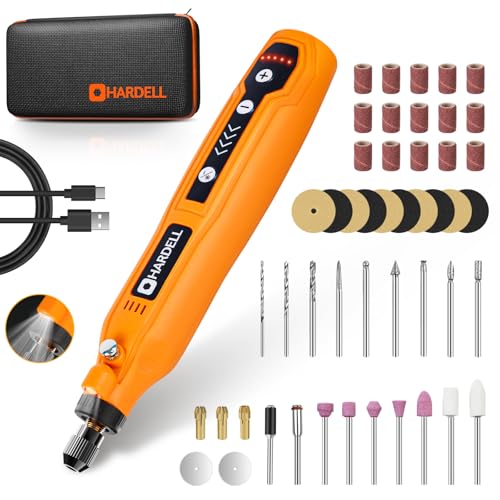
The HARDELL Mini Cordless Rotary Tool emphasizes portability and ease of use, making it suitable for jewelry enthusiasts who work on small surfaces. It offers five speed settings (5000/8000/11000/14000/18000 RPM), allowing for careful sanding, engraving, and polishing in stages. The kit includes a broad selection of 69 accessories, covering carving, sanding, grinding, and polishing tasks. The tool is compact and lightweight, enhancing control for delicate lines and fine details. While not intended for heavy-duty projects, it provides a versatile foundation for resin work, metal engraving, and intricate bead or charm customization.
Dremel Stylo+ Versatile Craft Rotary Tool

The Dremel Stylo+ combines precision with a comfortable pen-like design, ideal for jewelry detailing, wax carving, and glass etching. Its adjustable speed range from 5,000 to 22,000 RPM gives reliable control for delicate beadwork, engraving, and finishing work. A longer extension cord adds workspace flexibility, which is helpful when you’re working on larger pieces or at a dedicated studio table. This tool is well-suited for light-duty jewelry tasks where precision and steady hand control are essential, and it pairs well with a wide range of Dremel accessories.
PHALANX 180W Rotary Tool Kit

The PHALANX 180W Rotary Tool Kit delivers substantial power with a 6-speed range (8000–35000 RPM) and a 180W motor, making it capable of metal polishing, fine cutting, and precision carving needed in jewelry work. The keyless chuck and additional collets improve accessory stability, reducing wobble during engraving or grinding tasks. A robust 213-piece accessory set expands your options for metalwork, resin finishing, and intricate decorative work. This kit suits more demanding jewelry projects and those who frequently switch between materials and finishes.
Esakoya Cordless Rotary Tool

The Esakoya cordless option presents five speeds (3000/6000/9000/12000/15000 RPM) and a large 75-piece accessory set designed for a broad range of jewelry tasks, including sanding, polishing, engraving, and drilling. Its USB-C charging provides flexibility for studio or on-the-go projects, making it convenient for resin art, metalwork, and small repairs. The textured aluminum pen body and non-slip grip help maintain steady control during detailed work, while the varied accessories support resin deburring, bead finishing, and fine edge work.
Schtumpa Rotary Tool Kit (Corded)

Schtumpa’s corded kit emphasizes uninterrupted power and precision, offering four speed settings (10,000–22,000 RPM) and a lightweight, pen-like grip for long sessions of jewelry engraving, polishing, and fine grinding. The corded design provides consistent torque and steady RPM, beneficial for meticulous bead and metal finishing. The compact form factor and quiet motor are designed to reduce fatigue during extended detail work while maintaining reliable performance across common jewelry tasks.
Buying Guide
- Power and speed range: For jewelry making, a balance of torque and a broad RPM range supports engraving, polishing, and delicate cutting. Tools with 5–6 speeds or a variable speed range offer the most versatility.
- Corded vs cordless: Cordless models improve mobility in small studios or when working on larger pieces placed away from outlets. Corded tools provide constant power and steadier torque for longer sessions, which can be advantageous for resin finishing and metal polishing.
- Grip and weight: A pen-style grip or lightweight design reduces hand fatigue during extended detailing. An ergonomic handle supports precise control on fine lines and tight contours common in jewelry work.
- Accessory breadth: A broad accessory set (drill bits, grinding stones, polishing pads, sanding bands) accelerates workflow by reducing the need to switch tools. Compatibility with common collets (e.g., 1/16″, 1/8″) improves versatility.
- Chuck type and stability: A user-friendly, quick-change or keyless chuck speeds up accessory swaps. Stable clamping minimizes run-out and improves detail accuracy when engraving or engraving-heavy tasks.
- Material scope: Look for tools that handle metal, resin, glass, and wood common in jewelry projects. A higher-watt motor and cool-running design help maintain performance during resin work and metal finishing.
- Safety features: Overload protection, soft-start behavior, and adequate guards or shields protect delicate pieces and the operator during engraving and polishing.
- Maintenance and warranties: Reputable brands with readily available replacement accessories and spare parts reduce long-term downtime and ensure consistent performance across projects.
These selections provide a spectrum of options—from lightweight, cordless designs suitable for intricate beadwork to robust, accessory-rich kits capable of handling metal polishing and resin finishing. When choosing, consider your typical jewelry tasks, workspace constraints, and how often you rotate between engraving, polishing, and drilling to identify the best balance of power, control, and accessory availability.
Add a Comment