Finding the right rotary trimmer paper cutter depends on your workload, required precision, and workspace. This guide highlights five reliable models ideal for home offices, classrooms, or small print projects. Top picks are selected for ease of use, safety features, and accurate cuts. Whether you trim photos, cardstock, labels, or sublimation media, these cutters offer dependable performance. The following sections compare each product and explain who benefits most from them.
| Product | Best For | Key Benefit |
|---|---|---|
| Dahle 508 Personal Rotary Trimmer | Small to mid-volume cutting | Automatic clamp and self-sharpening blade |
| CARL Professional Rotary Paper Trimmer 18 inch | High-precision, versatile cuts | Carbide blade with stable base |
| Dahle 507 Personal Rotary Trimmer | Compact, light-duty trimming | Self-sharpening blade, automatic clamp |
| Fiskars SureCut Deluxe Paper Cutter | Budget-friendly, accurate cuts | SureCut technology and TripTrack system |
| CARL Heavy Duty Rotary Paper Trimmer 12238 | Heavy-duty projects | Carbide blade, patented rail, magnetic guide |
Dahle 508 Personal Rotary Trimmer, 18″ Cut Length

The Dahle 508 is designed for users who need an 18″ cut length with steady handling and safety. It features a self-sharpening blade and an automatic clamp that holds the work securely, reducing mis-cuts. The protective blade housing adds safety during operation. This model caters to small offices, craft enthusiasts, and teachers who trim moderate volumes of paper, photos, or cardstock.
Best for: light to medium workloads where dependable precision and safety are priorities. Why selected: combines long cut capacity with automatic clamping for smooth, consistent finishes. Limitations: not ideal for high-volume professional print runs due to moderate sheet capacity per cut.
CARL Professional Rotary Paper Trimmer 18 inch

The CARL 18″ professional trimmer is built for accuracy with a calibrated metal base and a premium carbide blade. It supports up to 10 sheets of 20 lb. paper per cut, offering stability through its robust base. This model is well-suited for classrooms, design studios, and office environments that require repeatable, precise trims on a range of paper weights.
Best for: users needing precise, repeatable cuts with a sturdy base. Why selected: reliable carbide blade and calibrated base reduce misalignment. Limitations: slightly heavier than compact models; may take more desk space.
Dahle 507 Personal Rotary Trimmer, 12″ Cut Length
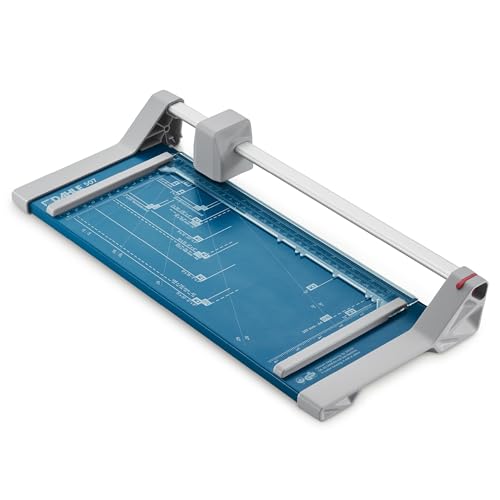
The Dahle 507 is a compact, 12″ cutter that emphasizes safety and ease of use. It features self-sharpening blades and an automatic clamp, making it a practical choice for small desks and lightweight trimming tasks such as photos, labels, or greeting card stock. Its smaller footprint suits users with limited workspace.
Best for: small spaces and light cutting tasks. Why selected: dependable safety features in a compact form factor. Limitations: shorter cut length limits some projects; not ideal for large sheets.
Fiskars SureCut Deluxe Paper Cutter
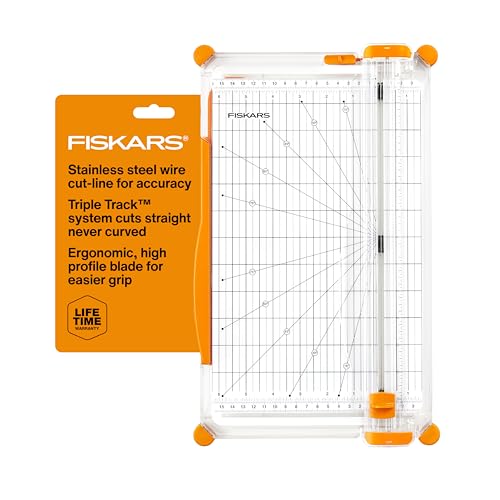
The Fiskars SureCut Deluxe offers precise cutting with its SureCut technology and a stainless steel wire cut-line. The TripTrack system helps keep the blade aligned with the cutting rail for stable, straight cuts. An extended blade arm adds versatility for longer or angled trims, making it a balanced option for classrooms, hobbyists, and small offices.
Best for: those who value easy alignment and consistent straight cuts. Why selected: combines accuracy features at a reasonable price. Limitations: may lack some rugged features of heavier-duty models for high-volume environments.
CARL Heavy Duty Rotary Paper Trimmer 12238
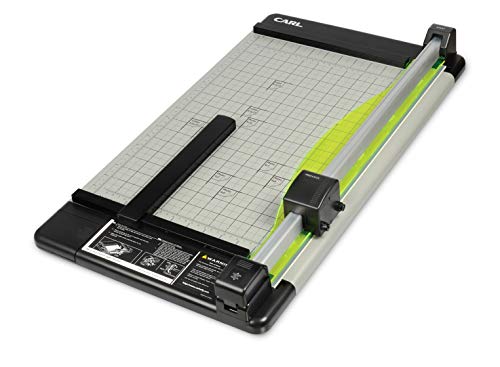
The 12238 model from CARL is a heavy-duty 18″ trimmer featuring a carbide blade, a patented rail system, and a magnetic paper guide. Its robust base and locking rail mechanism ensure accuracy for demanding trimming tasks, including larger project runs and heavier paper stocks. This is a strong choice for professional print setups or craft studios with sustained trimming needs.
Best for: heavy workloads and demanding trimming projects. Why selected: durable build and precise carbide blade support high-volume use. Limitations: larger, heavier, and less portable than compact models.
Buying Guide
What should you consider before buying a rotary trimmer? This guide outlines practical factors to help compare models and match them to your needs.
- Cut length: Choose 12″ to 18″ based on the largest standard sheet you trim. Longer cuts reduce reorientation and improve efficiency for cardmaking or photo projects.
- Sheet capacity: If you trim many pages per session, look for higher capacity and a sturdy base. Lower-end models handle 5–7 sheets; heavy-duty options exceed 15–20 sheets per pass.
- Blade quality: Carbide blades last longer and stay sharp, especially with frequent use. Self-sharpening designs simplify maintenance.
- Safety: Automatic clamps, blade housings, and guard rails reduce risk during operation. Ensure the model vendor specifies safety features clearly.
- Base stability: Calibrated metal bases and magnetic guides improve accuracy. A stable base minimizes misalignment and waste.
- Portability vs. durability: Compact cutters fit small desks; heavier-duty trims offer durability but require more workspace.
- Warranty and service: For frequent users, a model with a warranty and available parts can save downtime and costs.
Tips for Using a Rotary Trimmer
- Always align the paper with the ruler and guide to ensure straight cuts.
- Use the clamp for secure trimming to minimize shifting during blade contact.
- Replace blades promptly when you notice jagged edges or pulled fibers.
- Work on a clean, sturdy surface to prevent misalignment caused by vibration or wobble.
FAQ
- What is a rotary trimmer best used for?
Rotary trimmers are ideal for precise, straight cuts on paper, photos, cardstock, and light laminates. They are commonly used in offices, classrooms, craft rooms, and design studios.
- Do all rotary trimmers have automatic clamps?
Many models include automatic clamps, but some compact or budget options rely on manual clamps. Check product features to confirm.
- Which is better for thick materials: 12″ or 18″?
Longer cut lengths (18″) are better for larger sheets, while 12″ cutters are portable and sufficient for smaller tasks. For thicker stacks, a heavy-duty model with a robust base is preferable.
- Are carbide blades worth the extra cost?
Yes for frequent trimming; carbide blades offer longer life and smoother cuts, reducing blade replacement frequency.
- Should I choose a fixed base or a magnetic guide?
A calibrated fixed base with magnetic guides provides consistent alignment for batch trimming, especially in professional settings.
- How much space do I need?
Measure the footprint of the cutter plus room for paper stacks and a clearing area. Heavier models require more desk depth.
Add a Comment