Geology students and field enthusiasts rely on hand lenses to inspect minerals, rocks, and micro-features. This guide highlights five reliable hand lenses and optics kits designed for geology work, classroom demonstrations, and on-site field testing. Each option balances magnification, optics quality, and portability to help identify mineral properties such as hardness, streak, color, and luster with greater accuracy.
The following quick-reference table summarizes the chosen products and their standout features to help you compare at a glance.
| Product | Brand | Key Strength | Magnification | Notes |
|---|---|---|---|---|
| United Scientific Mineral ID Kit | United Scientific | Comprehensive classroom kit with multiple tools | Varies by tool (hand lens included) | Streak plates, glass plate, magnet, nail, penny, etc. |
| SE Illuminated 10X Loupe | SE | Bright LED illumination for detailed viewing | 10X | Portable, includes case and batteries |
| EISCO Mineral ID Kit | EISCO | 7-piece field/testing kit | Hand lens included within 7 pieces | Streak, magnet, copper square, retractable hand lens |
| DANOPLUS 10X Jewelers Loupe | DANOPLUS | High-quality triplet glass for precise inspection | 10X | No batteries required, portable |
| Rongon Pocket Folding Magnifier | Rongon | Compact, extra magnification in a foldable design | 30X | Protective case, anti-shock |
Below are five hand lenses or kits selected for geology work, with product-specific details and practical usage notes to help you decide which best fits your needs.
United Scientific Mineral ID Kit

This 7-piece kit supports foundational field testing and classroom demonstrations. It includes reusable streak plates, a glass plate, a dropper bottle, a magnet, a nail, a penny, and a hand lens. The toolkit helps students test mineral hardness, streak color, magnetic properties, appearance, and effervescence to identify minerals and mineral content within rock specimens. The set is designed for educators and beginners to explore geologic techniques in an approachable format.
SE Illuminated 10X Loupe

The SE Illuminated Loupe provides 10X magnification with a 21mm optical glass lens and two bright white LEDs. This combination enhances visibility for precise inspections of minerals, plant structures, jewelry, or biological samples in varying lighting conditions. Its compact folding design and included case make it convenient for field use or classroom demonstrations where consistent lighting is needed for accurate observations.
EISCO Mineral ID Kit

The EISCO kit offers a 7-piece set designed to explore field testing techniques for rocks and minerals. It emphasizes mineral identification through hardness, streak, magnetic properties, appearance, and effervescence. The included tools—streak plate, glass plate, dropper bottle, magnet, nail, copper square, and retractable hand lens—make it suitable for classroom labs and introductory fieldwork, providing a clear, practical approach to mineral identification.
10X Jewelers Loupe Hastings Triplet
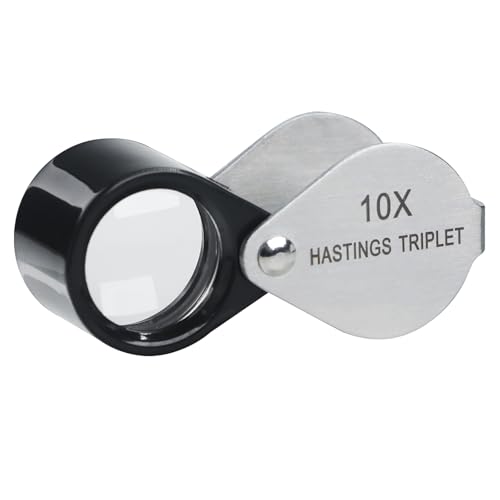
This 10X jewelers loupe features a Hastings triplet glass lens for sharp, distortion-free viewing of gems, minerals, coins, stamps, and watches. It does not require batteries and is foldable for portability, with an integrated eyelet for convenient attachment. The precision optics are well-suited for detailed mineral inspection in geology studies or fieldwork where compact, reliable magnification is essential.
Rongon Pocket Folding Magnifying Glass

The Rongon pocket folding magnifier offers a compact 30X magnification with a protective black coated case and anti-shock design. Its foldable format makes it easy to carry on field trips or classroom activities, enabling users to inspect fine mineral grains and textures with higher detail. This option suits geology students who require strong magnification in a portable package without bulky equipment.
Buying Guide
- Magnification range: For mineral identification, 5X–10X lenses are common for general inspection, while higher magnifications (e.g., 30X) are useful for examining fine grain structure in rocks and minerals. Consider pairing a mid-range loupe (10X) with a higher-magnification option for detailed work.
- Optical quality: Triplet or doublet lenses reduce distortion and improve edge clarity. Look for lenses with durable optical glass rather than acrylic where possible, especially for mineral analysis.
- Lighting: LED illumination helps with viewing color and surface features in low-light settings. If buying a non-lit loupe, plan for a reliable external light source or natural daylight.
- Portability: Folding designs, protective cases, and lanyards enhance field usability. For classroom kits, multi-tool sets provide broader educational value.
- Durability: Geo fieldwork can be rough. Choose coatings and housings that resist minor impacts and scratches, particularly for pocket or school use.
- Inclusion of educational tools: Kits with streak plates, glass plates, magnets, or other reference items can facilitate hands-on learning and structured experiments in geology courses.
- Price and value: While higher-end triplet lenses offer premium optics, budget-friendly options deliver reliable magnification for entry-level exploration. Balance cost against durability and included accessories.
- Maintenance: Clean lenses with proper microfiber or lens cleaning solutions. Avoid harsh chemicals that can scratch or haze the glass.
Add a Comment