Finding the right long arm quilting option for a first-timer can be challenging. This guide highlights beginner-friendly long arm and companion setup options that balance ease of use, reliability, and room to grow. Each pick focuses on accessible controls, solid support materials, and capabilities that help quilters move from simple patterns to more complex designs without getting overwhelmed.
| Product | Brand | Highlights |
|---|---|---|
| Q’nique 16X – Elite Long Arm Quilting Machine | The Grace Company | 16″ throat, ergonomic controls, bright throat light, fast up to 2100 SPM |
| Cutie Breeze Table Top Hoop Quilting Frame | The Grace Company | Portable, fits most desks, up to 19″ arm, frees motion quilting |
| Little Rebel Sewing And Quilting Machine | The Grace Company | All-in-one sewing/quilt, 13″ x 8.5″ throat, easy transitions |
| Brother CS7000X Computerized Sewing and Quilting Machine | Brother | 70 stitches, LCD, wide table, included feet |
| Brother XR3774 Sewing And Quilting Machine | Brother | 37 built-in stitches, automatic needle threader, top load bobbin |
The selections below are organized to help beginners build confidence—from a dedicated long arm option to compatible frames and capable domestic machines that pair well with learning free-motion quilting techniques.
Q’nique 16X Elite Long Arm Quilting Machine
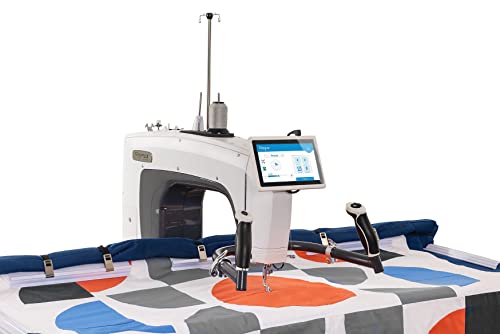
The Grace Company’s Q’nique 16X Elite offers a generous 16″ throat space, enabling large patterns with less maneuvering. It features ergonomic handles with two-button controls and a 7″ touchscreen for straightforward navigation. A bright throat light plus built-in bobbin estimator help beginners monitor stitching and thread usage, reducing guesswork during practice sessions. Speeds up to 2100 stitches per minute provide ample room to complete mid-sized patterns without sacrificing control. This unit pairs well with the Q-Zone quilting frame for stable maxi-quilting projects.
Cutie Breeze Table Top Hoop Quilting Frame

The Cutie Breeze turns almost any desk or table into a compact long-arm-friendly workstation. It supports up to an 8″ throat space on a familiar machine and can accommodate a longer arm (up to 19″) for growing quilters. The free-motion capability turns a standard home sewing machine into a quilting device, allowing beginners to practice meander and stipple patterns with more control. This setup is ideal for test-quilting on smaller projects or for learning free-motion basics before investing in a full frame.
Brother XR3774 Sewing And Quilting Machine

The XR3774 provides a strong foundation for beginners who want both sewing and quilting capability. It includes 37 built-in stitches, a one-step buttonhole, and an automatic needle threader with a jam-resistant drop-in top bobbin. A wide table and multiple included feet help users explore quilting ideas with consistent stitch quality. While not a dedicated long-arm, its feature set supports learning basic free-motion techniques and practice quilting on smaller projects before moving to larger surfaces.
Brother CS7000X Computerized Sewing And Quilting Machine

The CS7000X brings a broad stitch library (70 stitches) and a color LCD display to help beginners select appropriate patterns for quilting. It includes an automatic needle threader, a jam-resistant top drop-in bobbin, a wide table, and 10 feet plus a quilt guide. This machine supports longer quilting projects on larger fabrics and allows users to transition from piecing to free-motion quilting with guided assistance. It’s well-suited for learners who want a reliable, all-in-one option with strong support materials.
Buying Guide: Key Considerations For Beginners
- Purpose and space: Decide between a dedicated long-arm setup (or frame) and a versatile domestic machine. Space requirements and portability influence long-term use and future upgrades.
- Ease of use: Prioritize models with simple controls, intuitive touch interfaces, and clear LED or light guidance for visibility while stitching.
- Throat space: A larger throat space enables bigger patterns, but beginners may start with mid-size options (12–16 inches) to develop control before advancing to larger projects.
- Frame compatibility: If choosing a frame, ensure it matches your machine’s throat depth and mounting system. A compatible frame improves stability and quilting consistency.
- Free-motion capability: Look for features that support free-motion quilting, such as reliable presser foot control, glideable surfaces, and adjustable stitch speed.
- Needle and bobbin guidance: Automatic needle threaders and easy-tomatically wound bobbins reduce setup time and frustration during practice.
- Stitch variety: A broad but relevant stitch library helps explore quilting textures, while focused quilting features (like rulers or templates) support evolving projects.
- Support and education: Manufacturers offering robust manuals, online tutorials, and community support help beginners progress more confidently.
- Budget and growth: Start with a core setup that unlocks basic quilting tasks and leaves room to upgrade frames, accessories, or a dedicated long-arm later.
- Maintenance: Regular cleaning, oiling (per manual), and timely part replacements preserve stitch quality and machine life.
Across these options, beginners benefit from a calm, stepwise approach: practice basic straight-line work, then progress to curves and free-motion meanders. Packages that combine an easy-to-learn interface with stable hardware and accessible support tend to rank highest for early success in long-arm quilting and related free-motion techniques.
Add a Comment