The best 2 part epoxy clay for hobbyists and professionals combines ease of use with strong, durable results. This guide highlights five top epoxy clays that cure at room temperature, offer strong adhesion, and resist shrinkage. It helps modelers, restorers, and crafters pick the right option for sculpting, building, or repair work. Each product is evaluated for best use case, material compatibility, and practical limitations. A quick summary table follows to compare key details at a glance.
| Product | Best For | Hardening Time | Key Benefit |
|---|---|---|---|
| Epoxy Clay, Magic Epoxy Sculpt (EzyAce) | General sculpture and repairs | Few hours | Excellent adhesion to multiple substrates |
| 1 lb White Epoxy Putty Sculpt Clay (OAIEGSD) | Detail work & fills | Room temp | Two-in-one sculpting and repair |
| AB Epoxy Sculpt Clay 2 Part (Smalltongue) | High-detail models | 24 hours | Low shrinkage and high hardness |
| 4 lb White Epoxy Putty Sculpt Clay (OAIEGSD) | Large projects & bulk repairs | Room temp | Versatile for big builds |
| Aves-Apoxie Sculpt 2 Part (4 Pound) | Aquatic/outdoor and durable pieces | 24 hours | 0% shrinkage or cracking |
Epoxy Clay, Magic Epoxy Sculpt Clay
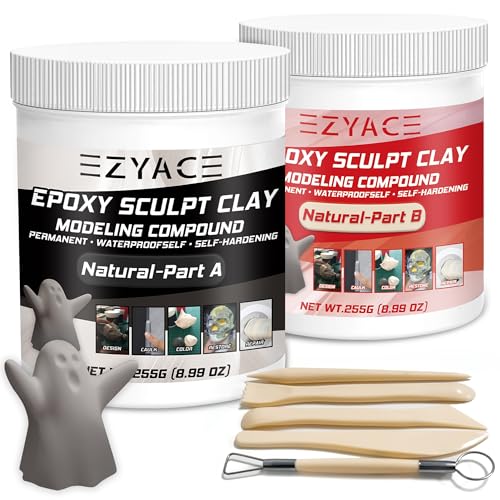
Brand: EzyAce. Features highlight versatile carving, modeling, restoration, and DIY use. Cures into a durable material that tolerates sanding, drilling, and detailed painting. Best for general sculpting and repair projects where a strong bond with plastics, ceramics, stone, wood, glass, and foam is beneficial. Cured epoxy shows resistance to heat and moisture.
Best for: hobbyists and professionals doing multi-material repairs or sculpture projects. Choose this if you need strong adhesion across a variety of substrates and plan to finish with fine detail painting.
Limitation: Some projects may require longer cure times for maximum hardness, and workability can vary with temperature and humidity.
1 lb White Epoxy Putty Sculpt Clay

Brand: OAIEGSD. This product blends sculpting texture with bonding putty, making it suitable for original sculptures, rebuilding sections, and detailed repairs. Self-hardens at room temperature, no ovens needed. Useful for figures, models, cosplay props, and restoration work.
Best for: users who want a two-in-one solution for sculpting and patching without heating. Better for detailed fill work on wood, metal, ceramic, and many rigid plastics.
Limitation: Cure time can reach a full day to achieve maximum hardness; project planning may be needed for longer cures.
AB Epoxy Sculpt Clay 2 Part

Brand: Smalltongue. Features include 1:1 A&B mix, non-shrinking cure, high viscosity, and high plasticity. It supports shaping with tools or hands, and is suited for model repair, sculpture, and texture-rich finishing. Cures at room temperature to a hard, durable finish with minimal shrinkage.
Best for: crafters who want reliable, steady sculpting with predictable shrinkage. Choose this if you need a sturdy final piece with good detailing and less risk of warping during curing.
Limitation: Full cure requires patience; avoid rushing with heat if you want maximum integrity.
Epoxy Sculpt Clay By Lubynia

Brand: Lubynia. Multifunctional epoxy clay for carving, building, repairing, and filling. Self-hardens with zero shrinkage and zero cracking, and forms a waterproof seal after curing. Noted for strong adhesion to plastic, ceramic, stone, wood, glass, and foam.
Best for: projects requiring waterproofing and surface repairs on ceramics or tiles, or for aquatic display pieces where moisture exposure is expected.
Limitation: Some projects may require longer cure times to reach full hardness depending on thickness and ambient conditions.
Aves-Apoxie Sculpt 2 Part (4 Pound)

Brand: Aves. A large 4-pound package that combines sculpting clay with epoxy adhesive properties. Self-hardening, waterproof, and designed to minimize shrinkage while delivering a semi-gloss finish. Suitable for jewelry, aquarium props, restoration, and woodworking.
Best for: large sculptures or heavy repair jobs where a bulk material reduces frequent re-supply. Choose this for outdoor or aquatic-themed pieces that require durability and water resistance.
Limitation: The larger size can be less convenient for small, detailed work and may require more storage space.
Buying Guide
What to consider when choosing a 2-part epoxy clay:
- Hardening time: If you need quick results, prefer clays that cure within hours. For detailed work, allow longer cure times.
- Adhesion and substrate compatibility: Look for compounds advertising bonds to plastic, ceramic, stone, wood, glass, and foam.
- Shrinkage and cracking: Zero or low shrinkage is preferred for precise details and durability.
- Water and heat resistance: If the project is exposed to moisture or outdoor conditions, select waterproof and weather-resistant formulas.
- Workability and detail: Some clays offer higher plasticity for fine modeling; others focus on bulk filling and repairs.
- Whitening and colorability: Consider whether you’ll paint or pigment after curing; some products allow pigments and sealers.
How to use epoxy clay effectively
Prepare surfaces by cleaning and roughening where needed. Mix A and B portions in the recommended ratio until uniform. Work quickly for detailed sculpting, then let cure at room temperature in a dust-free area. Finish with sanding, painting, and sealing as necessary to protect the final piece.
Compared to epoxy putty
Epoxy putty options emphasize fill, patching, and bonding alongside sculpting. If you need to repair gaps and holes while maintaining shape, these are strong contenders. If your focus is artistic sculpture, select a dedicated epoxy sculpt clay for better modeling control and finish.
FAQ
- How long does epoxy clay take to cure? Most cure within several hours to 24 hours depending on product and thickness.
- Can epoxy clay be painted after curing? Yes, most can be painted or finished with standard hobby paints after curing.
- Is epoxy clay waterproof after curing? Many options claim water resistance or waterproof sealing, but check specific product specs.
- Do I need ovens or heat to cure epoxy clay? No, most cure at room temperature without heating.
- Which epoxy clay is best for large projects? Larger packs from OAIEGSD and Aves offer bulk material suitable for bigger builds or repairs.
- Can I sand epoxy clay after it cures? Yes, most products withstand sanding after full cure.
Add a Comment