Discover the best 4 by 6 index cards for note taking, studying, flash cards, and everyday organization. This guide highlights five top options and explains who each is best for, along with practical buying tips. Whether you’re a student, teacher, office professional, or home organizer, you’ll find choices that balance durability, writing surface, and value. The table below provides a quick snapshot of why these selections stand out.
| Product | Best For | Why It Stands Out |
|---|---|---|
| Amazon Basics Ruled 4″ x 6″ 500-Count | Students and exam review | Many cards, ruled one side for easy notes, uniform cut edges |
| C-Line 4″ x 6″ Ruled (50/PK) | Back-to-school need, quick jotting & listings | Ruler on one side, blank on the other for versatility |
| Amazon Basics Blank 4″ x 6″ 1000-Count (2-Pack) | Creative notes and diagrams | Plain on both sides for drawings and diagrams |
| Oxford 4″ x 6″ Blank on Both Sides (100 Count, Pack of 5) | Large projects and planning | Blank on both sides for expansive ideas and layouts |
| Chell Heavyweight 4″ x 6″ 100 Count Ruled | Professional notes and formal presentations | 65 lb. cover weight for durability; ruled front, blank back |
Below is a detailed look at each option, with practical guidance to help you choose the right cards for your needs and workflow.
Amazon Basics Ruled 4″ x 6″ 500-Count
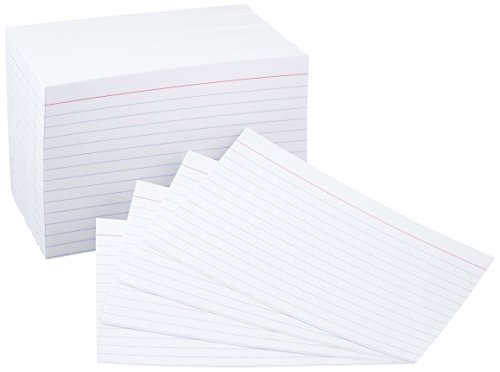
Best for organized study sessions and exam prep. These ruled index cards come in a large 500-count pack, offering plenty of writing surface for flash cards, quick notes, and flashcard-style study aides. The edges are precision-cut for uniform size, helping keep stacks neat in binders or organizers. Ideal for students who want a budget-friendly, high-volume supply without sacrificing consistency. Caution: Ensure you have a place to store large quantities to prevent misplacement.
C-Line 4” x 6” Ruled (50/PK)

Best for quick notes, lists, and mixed media use. This 50-card pack is compact and convenient for single-subject notes or on-the-go planning. The ruled surface on one side supports readable text, while the other side is blank for diagrams, quick sketches, or labeling. Choose this if you need a flexible, small quantity that travels well in a bag or pocket. Limitation: fewer cards per pack means more frequent restocking for large projects.
Amazon Basics Blank 4″ x 6″ 1000-Count (2-Pack)

Best for creative projects, diagrams, and freeform note taking. These 1000-count blank index cards offer a clean white surface with no ruling on either side, making them ideal for sketches, mind maps, or large math problems. They’re a solid choice for teachers designing visual aids or professionals who prefer a blank canvas. Caution: Writing may require more careful alignment without guidelines, especially for dense layouts.
Oxford 4×6 Blank on Both Sides (100 Count, Pack of 5)

Best for projects requiring ample space and double-sided notes. This set delivers a total of 500 blank cards across five packs, blank on both sides to maximize writing area for graphs, charts, and extended notes. Ideal for classrooms, planning sessions, and crafts that benefit from larger canvases. Limitation: Unruled cards demand careful writing alignment without margin guides.
Chell Heavyweight 4×6 Ruled

Best for durability-focused note taking, professional notes, and documentation. These 65 lb. cover weight index cards resist ink penetration, offering robust performance for lengthy notes. The front side is ruled for neat writing, while the back is blank for sketches or additional notes. Suitable for long-term projects or archival needs. Caution: Heavier weight cards can be less flexible in very tight binders.
Buying Guide: 4 by 6 Index Cards
What to consider when choosing 4 by 6 index cards:
- Surface: Ruled vs. blank. Choose ruled for quick notes; blank for diagrams and drawing.
- Weight and durability: Heavier weights resist ink bleed and wear, good for long-term use.
- Quantity: Large packs reduce per-card cost; smaller packs are portable.
- Color and finish: White is standard and compatible with most inks; colored cards help categorization.
- Finish and edges: Precision-cut edges ensure tidy stacks and neat storage.
How to choose by use case
- Study and flashcards: Look for ruled surfaces for legible notes and enough quantity to cover topics.
- Presentations and planning: Unruled or blank sides enable custom diagrams and mind maps.
- Professional notes: Heavier-weight cards reduce bleed-through and provide a premium feel.
Practical tips
- Store in a labeled box or tray to prevent loss and maintain organization.
- Use color-coded sections for subjects, topics, or priorities.
- Pair with a small highlighter or pen set for quick study sessions.
FAQ
- Q: Are 4″ x 6″ cards good for flash cards? A: Yes, they provide enough writing space without becoming bulky.
- Q: Should I choose ruled or blank for exam prep? A: Ruled helps with sentence-level notes; blank supports diagrams and formulas.
- Q: Is heavier weight better? A: Heavier weight cards resist ink bleed and are more durable for long-term use.
- Q: Do packs of 500 or 1000 offer better value? A: Larger packs typically reduce per-card cost, suitable for ongoing use.
- Q: Can these cards fit in standard organizers or bins? A: Yes, most 4″ x 6″ cards fit common storage boxes and organizers.
- Q: Are these cards suitable for dry-erase markers? A: Paper cards are best with ink; avoid dry-erase markers that may smear on non-porous surfaces.
Add a Comment