Answering the question “which 110 lb cardstock should I buy?” this guide highlights five top 110 lb (about 199 gsm) options that balance thickness, print quality, and usability for everyday projects, invitations, menus, and business materials. Ideal for crafters, designers, teachers, and small businesses, these selections cover printer compatibility, archival quality, and project versatility. Below you’ll find structured product sections, a quick buying guide, and practical FAQs to help you choose confidently.
| Product | Best For | Notes |
|---|---|---|
| Neenah Exact Index | Professional letters, menus, flyers | 94 brightness; traditional 8.5 x 11 |
| Veritas White Cardstock (WritePads) | Flawless laser/inkjet printing, certificates | 199 gsm; archival acid-free |
| Astrobrights White Cardstock | Invitations, crafts, bold prints | 235 sheets; 94 brightness |
| Hammermill White Cardstock | Direct mail, classroom projects | Made in USA; SFI certified |
| Weyew Cream Cardstock | Menu covers, greeting cards | Multiple thicknesses; cream color |
Neenah Paper Exact Index Card Stock, 110 lb

Best for professional letterheads, menus, and business documents that require a sturdy feel. The 110 lb index weight meets USPS 7 pt. minimum for certain mailings, while its 94 brightness and smooth finish support clean, legible printing. This option is favored for everyday projects where a premium card stock is not required to be ultra-thick, yet durability matters.
- What it’s best for: everyday business documents, menus, and letterheads.
- Why chosen: strong, reliable weight with a traditional 8.5 x 11 size.
- Caution: not the brightest option; may show more ink translucency on very light inks.
Veritas White Cardstock 110 lb (199gsm)

This heavyweight option is designed for printers that need a robust feel with sharp results. It is suitable for professional-quality printing, business cards, certificates, and invitations. The paper is acid-free, helping resist yellowing over time, making it a solid archival choice for documents you want to last.
- What it’s best for: certificates, resumes, and high-impact printed pieces.
- Why chosen: engineered for flawless results in laser and inkjet printers.
- Caution: ensure printer supports 199 gsm stock to avoid feeding issues.
Premium Astrobrights White Cardstock 110 lb
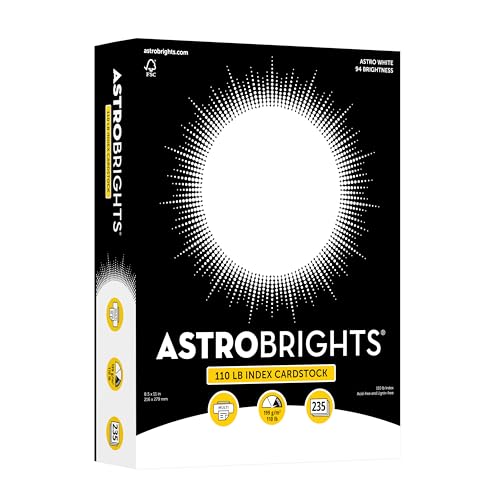
Best for invitations, party décor, and bold printed pieces that need a sturdy base with bright white color. The 110 lb index stock provides a premium feel, and the large 235-sheet pack ensures you have ample material for multiple projects. The 94 brightness supports clear, vibrant images and text.
- What it’s best for: invitations, menu cards, and presentation covers.
- Why chosen: heavier weight than standard printer paper with strong color reproduction.
- Caution: not the thinnest option for very fine score-and-fold work; consider scoring guidelines first.
20 Sheets, Heavy White Cardstock 110 lb

Compact for smaller projects or test prints, this 110 lb option offers a thick, durable feel in a 20-sheet pack. It’s ideal for drafts, prototypes, or small craft projects where a substantial base is needed but sheet count is a consideration.
- What it’s best for: small invitations, prototypes, and personal craft projects.
- Why chosen: convenient pack size with a robust weight.
- Caution: may not be cost-efficient for large-volume needs; evaluate long-term use.
Mzj.Office Card Stock Paper 110 lb

Best for versatile, creative projects that require a sturdy base. The 25-sheet pack provides a clean white surface with a smooth matte finish, suitable for cards, invitations, menus, and tags. It emphasizes a thick, professional feel while still fitting standard letter-size layouts.
- What it’s best for: cards, menus, inserts, and tags.
- Why chosen: 110 lb cover stock with 300 gsm feels substantial and easy to cut.
- Caution: check your printer’s media compatibility before loading to prevent jams.
Buying Guide: Key Considerations for 110 lb Cardstock
- Printer compatibility: Confirm your printer can handle 199 gsm stock. Some home printers may require manual feeding or specialty settings.
- Weight vs. stiffness: 110 lb stock is thicker and stiffer than standard copy paper, aiding durability and impression, but may be harder to fold cleanly without scoring.
- Brightness and color: Higher brightness (e.g., 94) makes text and images pop, while cream or tinted options offer a different look for invitations and menus.
- Acid-free and archival quality: For documents you want to last, choose acid-free stock to resist yellowing over time.
- Project type: For invitations or greeting cards, consider a stock with a smoother finish for clean printing. For menus or covers, a sturdier, thicker sheet can be advantageous.
- Consistency: If you run large batches, pick a brand with consistent sheet thickness and finish to ensure uniform results.
- Sheets vs. packs: Determine pack size based on project volume and feasibility of reordering; some brands offer larger packs for cost efficiency.
Frequently Asked Questions
- What is 110 lb cardstock equivalent in gsm? Yes, 110 lb index is approximately 199 gsm.
- Can I use 110 lb cardstock in an inkjet printer? Some 110 lb stock is compatible with inkjet printers, but check the manufacturer’s guidelines and use the appropriate paper setting.
- Is 110 lb cardstock good for cards? Yes, it provides a sturdy feel for greeting cards, invitations, and business cards.
- Does 110 lb stock warp easily? Proper storage and printer handling reduce warping; pick a high-quality, acid-free option to minimize this risk.
- Which brand is best for archival projects? Look for acid-free, archival-quality stock like Veritas White Cardstock for long-lasting prints.
- Is brightness important for readability? Higher brightness enhances contrast and readability, especially for black text on white stock.
Add a Comment