Answer: For removing heat transfer vinyl (HTV) from fabrics, choose a remover that is effective, quick-drying, and gentle on textiles. This guide highlights five strong options and explains who each is best for. Whether you’re refreshing a wardrobe, correcting a DIY project, or removing stubborn letters, these removers address various fabrics, vinyl types, and removal speeds.
The following quick-reference table helps compare the top picks at a glance. It focuses on who they suit, the format, and why they stand out for different buyer needs.
| Product | Brand | Format | Best For |
|---|---|---|---|
| AlbaChem Heat Transfer Vinyl Remover for Fabrics 20 fl. oz | AlbaChem | Liquid, 20 fl oz | All-around HTV removal on cottons and blends; powerful residue removal |
| AlbaChem Heat Transfer Vinyl Letter Remover – No. 1020 | AlbaChem | Liquid, 20 oz | Removing vinyl letters and residual adhesives quickly; best for letters |
| Heat Transfer Vinyl Remover for Fabrics, Without Damaging Fabrics-120ml | WeelenkEco | Liquid, 120 ml | Gentle on fabrics; effective on stubborn prints |
| WanKuMi Heat Transfer Vinyl Remover | WanKuMi | Liquid, 120 g (approx.) | Simple, beginner-friendly removal with included tools |
| JAOJAO Vinyl Remover for HTV Prints, 125ML | JAOJAO | Liquid, 125 ml | Two-step removal for standard transfers; good for small projects |
AlbaChem Heat Transfer Vinyl Remover for Fabrics 20 fl. oz

Best for: General HTV removal across a wide range of fabrics. This remover is noted as the most powerful residue remover among HTV products, with the ability to lift vinyl from several brands and materials. It dries quickly, which helps when you’re working on busy DIY projects or small alterations.
Why selected: Its strong solvent action targets adhesive residues from diverse HTV types, including common brands like Siser and Thermoflex. Fast drying minimizes downtime between steps, helping crafters stay productive.
Limitation: Because of its strength, test on delicate fabrics first to gauge fiber reaction and avoid potential color or texture changes on sensitive materials.
AlbaChem Heat Transfer Vinyl Letter Remover – No. 1020

Best for: Removing vinyl letters and residual adhesives from fabrics, especially when letters need quick removal. Great for projects that involve rebranding or removing names and numbers from apparel.
Why selected: It’s designed to be highly effective and dries fast, reducing the wait time between steps. The larger 20 oz bottle with an easy pour spout supports repeat removals without frequent restocking.
Limitation: It targets letters and adhesives; if you’re dealing with large graphic areas, you may need a product with broader coverage or repeated applications in layers.
Heat Transfer Vinyl Remover for Fabrics, Without Damaging Fabrics-120ml

Best for: Fabrics where gentleness is crucial. This remover emphasizes safety for textiles while delivering effective HTV removal, even on stubborn prints.
Why selected: It combines rapid action with a textile-safe profile, which helps avoid color fading, fabric hardening, or fiber damage. Suitable for everyday clothes and lightly decorated fabrics.
Caution: As with many removers, perform a patch test on an inconspicuous area to verify fabric compatibility before full use.
WanKuMi Heat Transfer Vinyl Remover

Best for: Quick removal with included tools that assist beginners and hobbyists. The kit-style presentation supports straightforward removal of simple designs.
Why selected: Its bundled tools make it practical for improvised setups—apply remover, wait, and peel with the scraper or tweezers. Aimed at rapid, approachable results for standard transfers on cotton or blends.
Limitation: Might require multiple passes for thicker or highly intricate designs; plan for sections to prevent drying before lifting edges.
JAOJAO Vinyl Remover for HTV Prints, 125ML
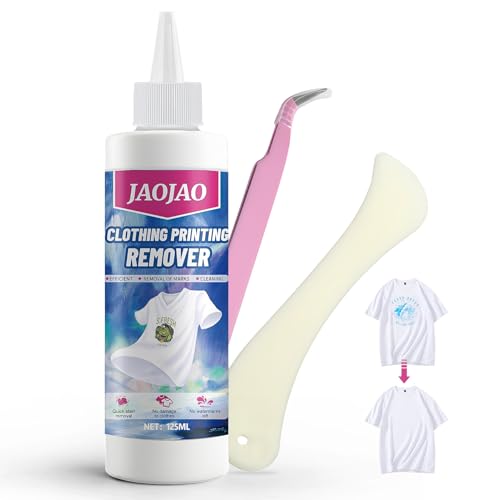
Best for: Two-step HTV removal on standard transfers, especially useful for smaller projects or repairs where precision matters.
Why selected: The two-step approach (apply, wait, lift) helps control the removal process and reduces risk of tearing delicate fabrics. Suitable for shirts, bags, hats, and similar textiles.
Limitation: Best for standard transfers; very thick or multilayer designs may require repeated passes or alternative methods.
Buying Guide: Choosing The Right HTV Remover
- Fabric compatibility: Look for removers that advertise textile safety and low risk of fiber damage. Delicate fabrics may require gentler formulas and shorter contact times.
- Removal speed: If you want quick results, prioritize products described as fast-drying or rapid-acting. For complex designs, consider two-step or layered removal options.
- Design type: Letters and simple graphics are often easiest to remove with letter removers; full-color graphics may benefit from stronger residue removers and repeat passes.
- Tooling and accessibility: Some options come with scrapers, tweezers, or pour spouts. Kits with tools can simplify the removal process for beginners.
- Test approach: Always test on a hidden fabric area to confirm colorfastness and fabric integrity before treating visible regions.
- Extended use: If you removals frequently, a larger bottle size can reduce refills and improve efficiency; for occasional use, smaller formats may suffice.
FAQ
- Question: Are HTV removers safe on cottons? Answer: Most HTV removers are formulated for fabrics like cotton and cotton blends, but always test a small area first to confirm there’s no color change or texture damage.
- Question: Do these removers need scraping? Answer: Some removers are designed to soften the adhesive so edges lift with minimal scraping; others require a scraper or tweezers for thicker designs.
- Question: Can I remove HTV without damaging the garment? Answer: Yes, by choosing a product labeled as fabric-safe or gentle and using short contact times and patch tests.
- Question: Is there a best remover for letters vs. graphics? Answer: Letter removers are optimized for removing letters and residual adhesives; for full graphics, consider a stronger residue remover with careful testing.
- Question: Should I use a remover on delicate fabrics like silk or satin? Answer: Proceed with extra caution or choose a remover explicitly marketed as safe for delicate fabrics, performing a test first.
Add a Comment