Answering the search intent: these graph-ruled loose-leaf papers are ideal for math, science, engineering, and precise note-taking. The top picks are best for students, professionals, and hobbyists who need clean grids, easy binder compatibility, and reliable paper quality. Each option is selected for grid clarity, hole-punch compatibility, and ink bleed resistance.
Summary of chosen products
| Product | Grid | Sheets | Binder Compatibility | |
|---|---|---|---|---|
| Five Star Loose Leaf Paper + Study App (170122) | Graph Ruled | 80 | 3-Hole Reinforced | Year-long daily notes and diagrams |
| Oxford Filler Paper (62360) | 4×4 Graph Rule | 400 Sheets | 3-Hole Punched | Math-heavy coursework and geometry |
| Amazon Basics Graph Ruled Loose Leaf (6-Pack) | 4×4 Grid | 600 Sheets total | 3-Hole Punched | Bulk projects and drafting |
| Vishoitty 130 Sheets Loose Leaf Graph Paper | 4×4 Graph | 130 Sheets | 3-Hole Punched | Clear grids and smooth writing |
| WritePads Graph Paper Loose Leaf (300 Sheets) | 4×4 Quad Ruled | 300 Sheets | 3-Hole Punched | Bulk school or office use |
Below are five product-focused sections to help you compare quickly. Each entry notes who it’s best for, why it was selected, and a practical caveat.
Five Star Graph Ruled Loose Paper (170122)

Best for students who need durable filler that withstands year-long use. The Five Star reinforced filler paper is double the strength of typical options and resists ink bleed, making it suitable for both notes and sketches. The sheet size is 8.5″ x 11″.
Who it’s best for: daily note-takers and busy students who require sturdy pages. Why selected: durability and graph-ruled format support both writing and drawing tasks. Caution: not ideal if you need heavy-volume bulk at a low price point.
Oxford Filler Paper With Graph Rule (62360)
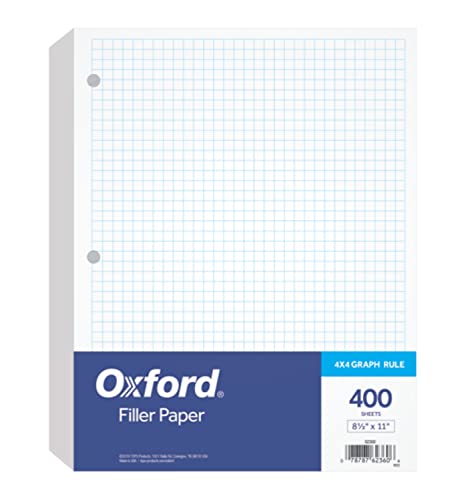
Best for curricula-heavy math and STEM work. This pack contains 400 double-sided sheets with 4×4 graph ruling, designed for 3-ring binders. The 8.5″ x 11″ sheets are standard for many classroom binders.
Who it’s best for: classrooms or homes needing large supplies for math-heavy courses. Why selected: abundant supply and universal binder compatibility. Caution: bulk size may be more than needed for light users.
Amazon Basics Graph Ruled Loose Leaf (11″ x 8.5″)

Best for bulk projects and drafting tasks. This six-pack provides 600 sheets total, with 4×4 grid ruling ideal for precise graphs and calculations. Paper is designed to minimize ink smearing for clean notes.
Who it’s best for: students and professionals who need a reliable bulk option. Why selected: value and consistency across a multi-pack. Caution: bulk packs require binder space and organization.
Vishoitty 130 Sheets Graph Paper (8 x 10.5)

Better for individual projects requiring clarity and smoothness. The 4×4 quad grid provides precise graphs, curves, and plans. Each sheet is thick enough to resist bleed and is not prone to sticking when turned.
Who it’s best for: students and hobbyists focusing on graphs and diagrams. Why selected: balance of sheet count and grid clarity. Caution: fewer sheets than other bulk options may require frequent replacements.
WritePads Graph Paper Loose Leaf (300 Sheets)

Best for classrooms and offices needing a dependable, long-lasting supply. This 8 x 10.5-inch paper features 4×4 quad ruled grids and is 3-hole punched for standard binders. Made in the USA with 65 GSM quality paper.
Who it’s best for: bulk users who prioritize consistent grid quality and easy binder management. Why selected: bulk quantity and reliable writing surface. Caution: as with other bulk options, storage space matters and may affect organization over time.
Buying Guide: Key Purchase Considerations
What grid style fits your needs? Quadruple 4×4 grids are standard for math and technical drawing, while other formats may emphasize readability for notes. Consider how precise you need your graphs to be and whether you’ll be writing with pencil, gel, or ink.
Are you using standard binders? Check hole punch compatibility and binder size. Most options use 3-hole punches for common ring binders, but confirm if you use a different binder system or require perforation customization.
How many sheets do you need? If you draft daily diagrams, a higher-sheet count can reduce replacement trips to the store. For casual note-taking, mid-range counts may be more economical and space-efficient.
Do you require bleed resistance? Bleed-through matters when using ink or markers. Some papers are optimized to minimize bleed, while others perform best with pencils or gel pens.
Is durability important? Reinforced bindings or thicker paper can extend the life of your notes and reduce tearing at the edges, especially in backpacks or binders carried every day.
FAQ
- What is graph-ruled loose-leaf paper best used for?
Graph-ruled loose-leaf is ideal for math, engineering, and science work where precise grids help with graphs, sketches, and calculations.
- Do all these papers fit standard three-ring binders?
Yes, all listed options use 3-hole punches to fit standard 3-ring binders.
- Is thicker paper better for ink bleed protection?
Generally, thicker paper and coated or higher-quality stock reduce bleed. Look for terms like bleed resistance or 65–70 GSM ranges.
- Which option is best for bulk class use?
Amazon Basics and Oxford offer bulk sheet counts, making them suitable for classrooms and long-term projects.
- Should I choose reinforced paper?
Reinforced paper lasts longer under heavy use and reduces tearing in frequently opened and closed binders.
Add a Comment