Nylon 3D printer filament offers toughness, high heat resistance, and excellent wear performance for engineering parts, gears, and functional prototypes. This guide highlights five top nylon filaments and explains who benefits most from each option. The featured products emphasize strength, dimensional stability, moisture handling, and compatibility with common FDM printers. Use this guide to compare best-for scenarios, determine moisture management needs, and choose filaments that balance cost with performance.
Overview table of select products:
| Product | Best For | Notes |
|---|---|---|
| OVERTURE Nylon Filament | Prototyping and durable parts | CoPA blend, good adhesion with PVA glue |
| Polymaker Fiberon PA612-CF15 | High-speed, high-strength parts | Carbon fiber reinforcement, low moisture sensitivity |
| SUNLU Easy PA Nylon Filament (Warp-Free) | Complex prints, large parts | Low warp, PC spool |
| YXPOLYER PA6 Nylon Filament | Automotive/industrial components | High heat resistance |
| ELEGOO PAHT Carbon Fiber Filament | High-temperature environments | Carbon fiber reinforcement |
OVERTURE Nylon Filament 1.75mm

Best for: engineering prototyping and durable parts. This copolymer nylon blends Nylon 6 and Nylon 6.6 for strength and toughness with heat resistance up to 180°C. Its odorless printing and minimal warping make it suitable for mid to high-temperature parts where reliability matters. The design includes a viewing hole and reel features to help track remaining filament, aiding organized printing sessions. Caution: nylon is moisture-sensitive, so store in a dry bag when not in use.
Polymaker Fiberon PA612-CF15 Carbon Fiber Nylon

Best for: high-speed printing with strong, lightweight parts. Fiberon PA612-CF15 is carbon fiber reinforced nylon, offering better stiffness and mechanical properties than standard nylon filaments, with lower moisture sensitivity. It’s well suited for industrial tooling, automotive components, and end-use parts that require rigidity. Caution: carbon fibers can wear nozzle components; ensure a suitable hardened nozzle if printing at high speeds.
SUNLU Easy PA Nylon Filament 1.75mm Warp-Free
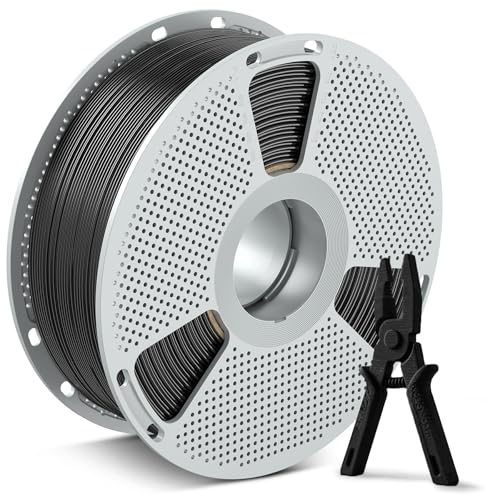
Best for: large or complex parts where warping is a concern. SUNLU Easy PA 1.75mm nylon filament emphasizes low shrinkage and warp-free printing thanks to a Nylon 6/66 copolymer formulation. It delivers high strength and impact resistance, making it suitable for gears, housings, and load-bearing components. Caution: as with most nylons, it benefits from proper drying and moisture control to maintain dimensional accuracy.
YXPOLYER Nylon Filament PA6 1.75mm
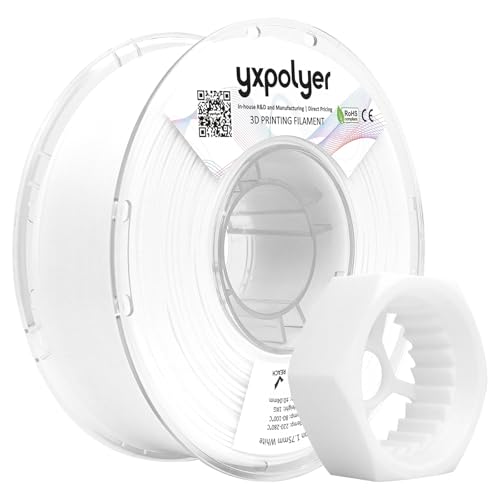
Best for: high-temperature durable parts. This white PA6 nylon filament is noted for toughness, high heat resistance up to 194°C, and excellent abrasion resistance. It suits gears, bearings, and moving components where low friction and long-term performance matter. Caution: higher printing temperature and moisture sensitivity require printer calibration and dry storage for best results.
ELEGOO Carbon Fiber PAHT Filament

Best for: high-temperature needs with added stiffness. ELEGOO PAHT Carbon Fiber filament blends PAHT with carbon fibers to boost strength and rigidity, while maintaining resistance to corrosion. It’s designed for use in enclosed printers and high-temperature environments. Caution: carbon fiber filaments can wear nozzles; use a hardened steel nozzle and appropriate print settings. This filament is ideal for aerospace-like components or tooling that requires heat resistance.
Buying Guide
- Moisture management: Nylon absorbs moisture quickly. Look for desiccant storage and consider drying the filament before prints for consistent results.
- Printer compatibility: Most nylon filaments work with common FDM/DLP printers, but nozzle wear and print temperature can vary. Hardened steel nozzles may extend life for carbon fiber blends.
- Dimensional stability: Copolymer blends (Nylon 6/66) often reduce warping and shrinkage, beneficial for large prints and complex geometries.
- Print settings: Expect higher extrusion temperatures and longer print times compared to PLA. First-layer adhesion can be improved with appropriate bed surfaces and adhesives.
- Mechanical targets: Choose carbon fiber reinforced nylons for stiffness; standard PA6/PA12 variants for toughness and abrasion resistance.
- Safety and handling: Some nylons can emit fumes or require ventilation. Use in a well-ventilated area and follow spool storage recommendations.
FAQ
- What is the main advantage of nylon filament over PLA?
– Nylon offers higher strength, impact resistance, and durability, making it better for functional parts that endure wear and stress. - Why does nylon require drying before printing?
– Nylon readily absorbs moisture, which can cause sizzling, poor layer adhesion, and warping; drying helps maintain print quality. - Are carbon fiber nylons worth it for beginners?
– They provide higher stiffness and heat resistance, useful for structural parts, but may require hardware upgrades and careful printer tuning. - Which nylon is best for gears and bearings?
– Low-friction PA6 or PA6/66 copolymers with good abrasion resistance are ideal for moving components; carbon fiber variants add stiffness if needed. - Can I print nylon on a standard printer without a heated bed?
– A heated bed is typically recommended; check the filament’s temperature range and printer capabilities to avoid issues with adhesion. - How should I store nylon filaments to maintain quality?
– Keep them in a dry, airtight bag with desiccant and away from humidity to minimize moisture uptake.
Add a Comment