Looking for a carbon fiber reinforced PLA filament that delivers higher stiffness, better layer adhesion, and reliable dimensional stability? This guide reviews five top options ideal for functional parts, drones, brackets, and detailed prototypes. The best choice depends on your printer, tolerance needs, and how you balance print quality with easing setup. Below, discover who each product is best for and why it stands out.
Summary of chosen products
- LANDU Carbon Fiber PLA Filament – Best overall for strong, reliable prints with excellent moisture protection
- ELEGOO PLA-CF – Best for consistent feeding and high accuracy
- FLASHFORGE Carbon Fiber PLA Filament – Best value for durable, smooth finishes
- Creality PLA Carbon Fiber Filament – Best for higher strength-to-weight balance
- Polymaker Carbon Fiber PLA Filament – Best for robust, satin/matte finish and ease of use
| Product | Brand | Best For | Key Benefit |
|---|---|---|---|
| LANDU Carbon Fiber PLA Filament | LANDU | Prototypers, functional parts | Pre-dried, vacuum-sealed for moisture control |
| ELEGOO PLA-CF 1.75mm | ELEGOO | Precision parts, high accuracy | Machine-wound for minimal tangling |
| FLASHFORGE Carbon Fiber PLA | FLASHFORGE | Durable prints on a budget | Low warp, high abrasion resistance |
| Creality PLA Carbon Fiber | Creality | Strong mechanical parts | 30% higher mechanical properties vs PLA |
| Polymaker Carbon Fiber PLA | Polymaker | High-quality finishes | Satin/matte finish with good bed adhesion |
LANDU Carbon Fiber PLA Filament 1.75mm Black 1KG

Material: PLA with carbon fiber reinforcement. Best for strong brackets, gears, drone frames, and automotive components. Provides high strength, stiffness, and impact resistance while maintaining PLA ease of printing. Notable for smooth matte finish and dimensional stability.
Who this is for: This filament is ideal for designers and engineers who need functional parts with good surface quality and reliability. It’s a solid all-around choice for hobbyists seeking engineering-like performance from a PLA base.
Why selected: It combines carbon fiber reinforcement with tight dimensional control and a moisture-protective packaging approach (pre-dried and vacuum-sealed). It minimizes warpage and improves layer adhesion, making it suitable for complex designs.
Caution: As with all carbon fiber filaments, wear on nozzles can increase; ensure proper cooling and a hardened nozzle if printing high-strength parts.
ELEGOO PLA-CF 3D Printer Filament 1.75mm Black 1KG
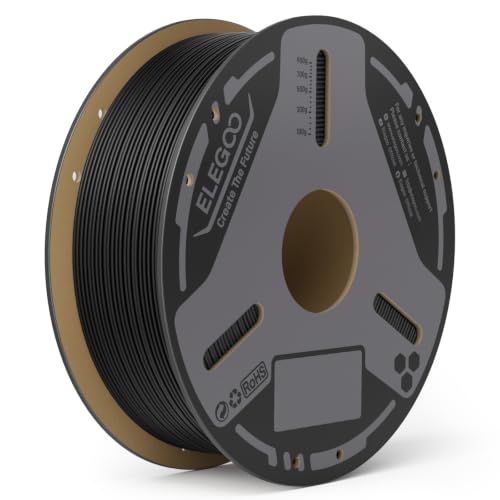
Material: Carbon fiber reinforced PLA for enhanced strength and rigidity. Designed for durable, impact-resistant components with better layer adhesion and a smoother finish. Optimum diameter accuracy helps consistent extrusion.
Who this is for: This is a strong pick for users prioritizing precise dimensions and reliable feeding across complex geometries. Suitable for functional parts that demand tighter tolerances.
Why selected: It emphasizes high accuracy (+/- 0.02 mm) and a careful winding pattern to reduce tangling and nozzle jams, making it easier to achieve repeatable results on a range of printers.
Caution: While strong, carbon fiber elements can be abrasive to nozzles; consider a hardened steel nozzle for long-term use.
FLASHFORGE Carbon Fiber PLA Filament 1.75mm

Material: Carbon fiber reinforced PLA designed for higher strength and rigidity. Aims to improve mechanical performance while keeping printing straightforward. Notable for a smooth finish and reduced inter-layer gaps.
Who this is for: Best for those who want lightweight, robust parts with a good surface that are easy to post-process. Useful for drone frames, brackets, and functional prototypes.
Why selected: Emphasizes low warp and reliable extrusion, with drying and desiccant packaging to minimize moisture-related issues during printing.
Caution: The filament is slightly more abrasive; monitor nozzle wear over many prints.
Polymaker Carbon Fiber PLA Filament Black 1KG

Material: Carbon fiber reinforced PLA offering high strength and rigidity with a satin/matte finish. Aims to deliver smooth-looking prints with strong bed adhesion and reliable layer bonding.
Who this is for: Suitable for builders seeking a refined surface finish and dependable performance for detailed prototypes and end-use parts.
Why selected: Combines strong mechanical properties with a visually appealing finish. Filament is designed to be tangle-free and moisture-protected for consistent results.
Caution: Always handle the spool to prevent tangling; store properly with desiccant to maintain print quality.
SUNLU Carbon Fiber PLA Filament 1KG Black

Material: Carbon fiber reinforced PLA with a 15% carbon fiber load. Designed to increase strength and maintain reasonable printability. Tolerances are stated at +/- 0.02 mm.
Who this is for: Ideal for hobbyists and professionals who want a robust, easy-to-print filament without sacrificing speed or surface quality.
Why selected: Offers a balanced option with reliable dimensional accuracy and broad compatibility across FFF 3D printers.
Caution: Performance can vary with nozzle materials; use 190–230°C nozzle temperatures and a heated bed if required by your printer setup.
Buying Guide: Carbon Fiber PLA Filament—Key Considerations
What makes carbon fiber PLA different?
Carbon fiber PLA blends standard PLA with short carbon fibers to boost stiffness, strength, and dimensional stability. The result is parts that resist warping and maintain intricate details better than regular PLA, while still printing at PLA-like temperatures and speeds.
What should you check before buying?
- Diameter and tolerance: Commonly 1.75 mm with +/- 0.02 mm, which affects consistent extrusion.
- Moisture protection: Pre-dried spools and vacuum sealing help prevent bubbles and jams.
- Mechanical properties: Look for claims about tensile strength, rigidity, and impact resistance.
- Finish and surface: Matte or satin finishes can influence post-processing and appearance.
- Toughness vs. printability: Higher strength often implies slightly more challenging prints; consider your printer capabilities.
Printer compatibility and settings
- Use a hardened nozzle if printing at high carbon fiber content to reduce wear.
- Start with buffer settings close to PLA: temperatures around 190–230°C and bed temperatures as required by your material and printer.
- Adjust fan speed to balance layer adhesion and surface finish for carbon fiber composites.
Tips for best results
- Store filament in a dry environment; moisture can cause bubbles and poor extrusion.
- Calibrate extrusion width and retraction to minimize stringing and tangling.
- Preview prints with supports to handle stiffer materials that may warp on complex parts.
Which product should you choose?
- Best all-around: LANDU Carbon Fiber PLA Filament for a balance of strength, finish, and moisture protection.
- Best for precision: ELEGOO PLA-CF for tight tolerances and reduced tangling.
- Best value: FLASHFORGE Carbon Fiber PLA Filament for strong parts at a lower cost per spool.
- Best for maximum strength: Creality PLA Carbon Fiber Filament for higher mechanical properties.
- Best for finish quality: Polymaker Carbon Fiber PLA Filament for satin/matte finishes and reliable bed adhesion.
FAQ
- Q: Is carbon fiber PLA suitable for functional drone parts? A: Yes, due to improved stiffness and strength, but ensure nozzle wear is managed and print settings are optimized for carbon fiber blends.
- Q: Do all 3D printers work with PLA-CF filaments? A: Most FDM/FFF printers handle PLA-CF, though some older machines may struggle with rigidity or require a larger nozzle.
- Q: How should I store carbon fiber filaments? A: Keep in a dry, sealed container with desiccant to prevent moisture absorption.
- Q: Will PLA-CF prints require post-processing? A: Finishing may be similar to standard PLA, but expect a matte finish and smoother surfaces due to carbon fiber interaction.
- Q: Can I mix carbon fiber filaments from different brands? A: Mixing brands is not recommended for critical parts due to potential differences in density, shrinkage, and color alignment.
- Q: Should I use a heated bed with PLA-CF? A: A heated bed is often optional but can improve adhesion for larger parts; follow each brand’s guidelines.
Add a Comment